Dental Uv Resin is a light-curable material used in selected dental and laboratory workflows. Depending on its formulation, it may support printed models, prototypes, trays, or other components. The name can sound universal. It is not. “UV resin” describes a curing approach, not a single material with identical properties or intended uses.
In practice, a dental professional or trained laboratory technician checks the product’s intended indication, wavelength range, and curing instructions before use. The resin may require a specific printer, washing process, and post-curing unit. A blue-violet light source alone may not be enough. Small details matter: uncured residue, rough surfaces, or incomplete polymerization can affect fit and material performance. Safe handling also means using appropriate protective equipment and following the product’s safety data sheet.
This guide explains what Dental Uv Resin is, how light curing works, and where the material may fit into dental workflows. It also distinguishes laboratory applications from materials intended for direct use in a patient’s mouth. That distinction is easy to overlook. Product labels and supporting evidence should guide decisions, rather than the word “dental” alone. Materials and protocols can vary, so a general overview cannot replace manufacturer instructions or a qualified clinician’s judgment.
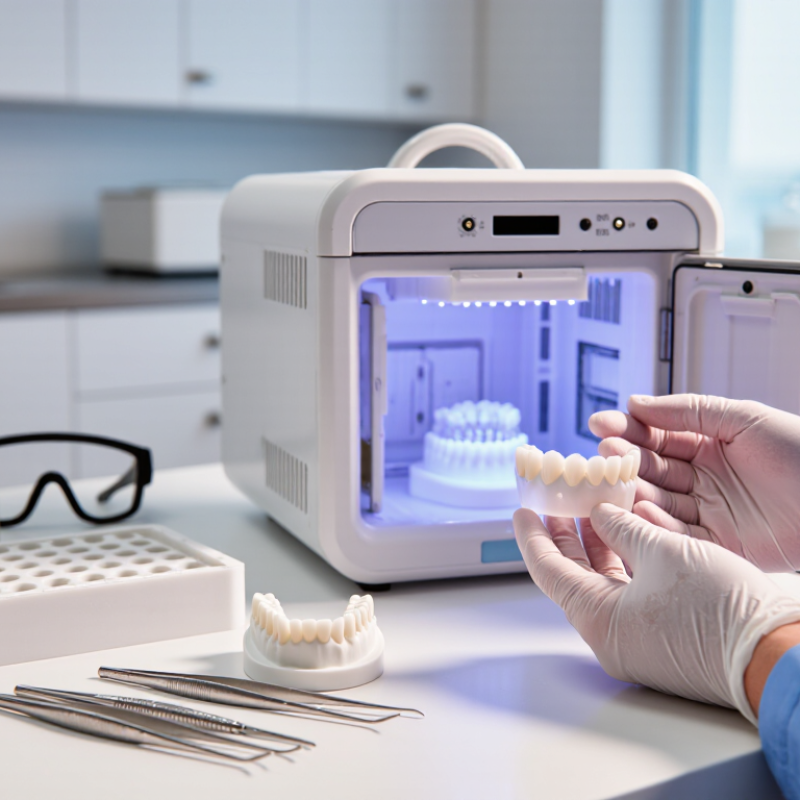
Dental UV resin is a liquid photopolymer that hardens when exposed to light. In dental 3D printing, many formulations respond to near-UV or violet light around 385–405 nm. Exposure links reactive molecules into a solid network, building a model or appliance layer by layer. Small details matter. Resin viscosity affects how it flows across the build area, while exposure settings influence feature sharpness and curing depth. Shrinkage during polymerization can also affect fit. I would not treat “UV resin” as one uniform material; its properties depend on formulation and intended use.
Wohlers Report 2024 estimated global additive manufacturing revenues at $20.0 billion in 2023, an 11.1% rise from 2022. That figure covers the whole sector, not dental resin alone, but it shows the expanding production context. Dental resins may be intended for models, surgical guides, or provisional devices; one formulation is not automatically suitable for every use. The final part depends on printer settings, washing, and post-curing. ISO 10993-1 outlines a risk-based framework for evaluating biological safety, but compliance claims must match the specific material and use. A smooth, hard surface can look finished and still be under-cured. That distinction is easy to miss.
| Dimension | Description | Typical Details and Practical Notes |
|---|---|---|
| Definition | Dental UV resin is a light-curable polymer material used to produce dental models, appliances, and other laboratory items. | In dental 3D printing, “UV resin” commonly refers to a liquid photopolymer cured by a printer’s light source. The term may also be used informally for materials cured by violet or near-ultraviolet light. |
| How curing works | Light activates photoinitiators in the resin, starting a chemical reaction that links liquid molecules into a solid polymer. | Many dental resin printers use light around 385 or 405 nm. The compatible wavelength depends on the resin and printer; follow their specified settings. |
| Common dental applications | Photopolymer resins are formulated for specific tasks, such as printing study models, surgical guides, splints, or temporary restorations. | A resin suitable for one application is not automatically suitable for another. Use only materials specifically indicated for the intended dental use. |
| Physical state before curing | Typically a pourable liquid that becomes solid when exposed to the appropriate light. | Viscosity and handling characteristics differ among formulations and can affect printing, cleaning, and detail reproduction. |
| Curing process | Printed parts are generally washed to remove uncured resin and then post-cured with a suitable light-curing unit. | Washing method, post-curing wavelength, time, and temperature are material-specific. Inadequate processing can affect the part’s properties and safe use. |
| Dimensional accuracy | Accuracy depends on the resin, printer, build orientation, support design, and post-processing. | Follow the validated workflow for the material and printer, and verify fit when the application requires precise dimensions. |
| Mechanical properties | Strength, stiffness, flexibility, and wear resistance vary widely by formulation and intended application. | Use the manufacturer’s technical data for the selected resin rather than assuming that all dental photopolymers have the same performance. |
| Color and appearance | Resins may be supplied in different shades, translucencies, or opacities. | Appearance is formulation-dependent and may change after printing, washing, or post-curing. |
| Biocompatibility | Biocompatibility is specific to the material and its intended contact with the body. | Do not assume a general-purpose or model resin is safe for intraoral use. Check its intended-use labeling and required processing instructions. |
| Handling and safety | Uncured resin may irritate skin or eyes and should be handled carefully. | Use the safety data sheet, suitable gloves and eye protection, adequate ventilation, and the prescribed procedures for spills and disposal. Avoid skin contact with uncured material. |
| Important distinction | Dental 3D-printing resins are not interchangeable with conventional light-cured dental composites. | Chairside composites and other dental materials have their own curing devices, indications, and clinical protocols; use each material only as directed. |
No. Many materials cure under blue visible light, often near 468 nanometers. The label can mislead.
The resin matrix may contain dimethacrylates. Silica or glass fillers improve strength and wear resistance.
Light activates a photoinitiator. Reactive species then connect resin molecules into a solid polymer network.
Wavelength, light output, exposure time, distance, and layer thickness all matter. Small details matter.
Not always. A surface may look hard while deeper material remains partly uncured.
Light may reach the material unevenly. Shaded areas and narrow channels can remain softer.
Wear suitable gloves and eye protection. Use good ventilation. Keep liquid resin away from skin and work surfaces.
Not necessarily. Excess exposure can increase heat, while shade and access still limit curing.
Clean it thoroughly and complete the specified post-curing process. A hard-looking part can still be incomplete.
No. Parts may warp, fit poorly, or wear under chewing forces. The intended indication matters. I might underestimate fit problems.
Dental Uv Resin is a light-activated material used in dentistry for selected restorative, modeling, and repair tasks. It typically contains resin monomers, fillers, and photoinitiators. When exposed to a suitable dental curing light, the photoinitiators trigger a chemical reaction that hardens the material. Its handling properties can make it useful for creating precise shapes, though strength, flexibility, and suitability vary according to the formulation and intended application.
Use generally involves preparing the work area and tooth or dental model as appropriate, applying the resin in controlled layers, shaping it, and curing each layer for the specified time and distance. The finished material may then be checked, trimmed, or polished. Safe handling matters: uncured resin can irritate skin or eyes, and curing light should be used with suitable eye protection. Dental Uv Resin is not appropriate for every clinical situation, and incomplete curing, poor bonding, or excessive exposure can affect results. Its use should follow product instructions and professional judgment.

 Ever Ray