 Ever Ray
1 / 1
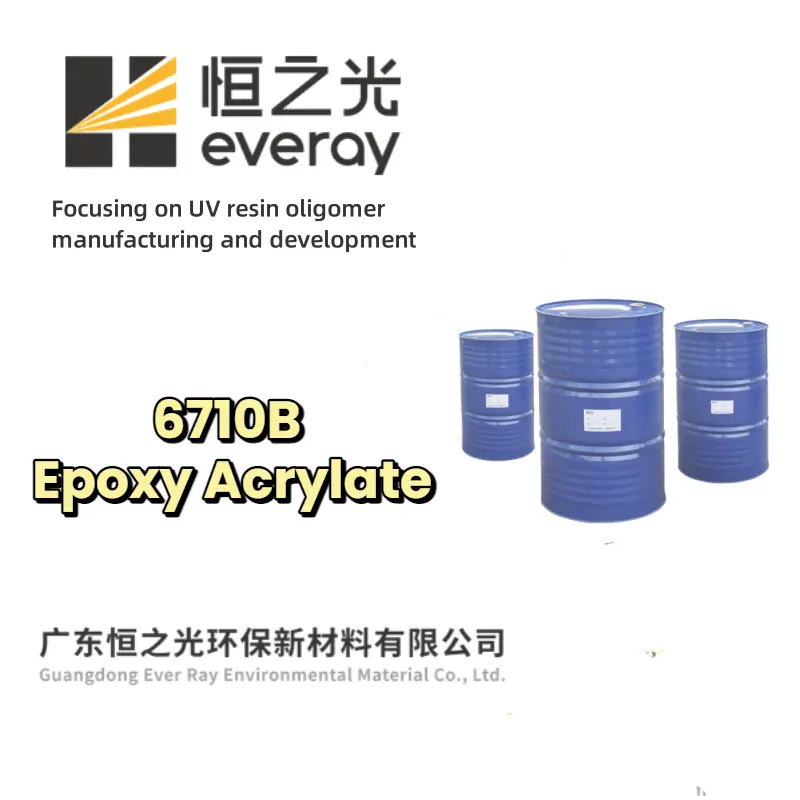
Epoxidized Soybean Oil Acrylate 6710B: A New Benchmark UV Resin for Cost-Efficiency and Quality
In the UV coatings industry, Epoxidized Soybean Oil Acrylate 6710B stands out with five key advantages—fast curing speed, excellent leveling, superior film-forming properties, low curing shrinkage, and outstanding substrate/filler wetting. It is an innovative choice for cost-effective applications such as wood primers and paper coatings, empowering manufacturers to reduce costs, improve efficiency, and overcome process bottlenecks.
Engineered with optimized photoreactivity, 6710B achieves rapid surface and through-cure in just 3-5 seconds, increasing production line efficiency by over 30%. It is especially suitable for high-speed roll coating and spray applications, significantly reducing energy consumption and processing time.
Its low viscosity and self-leveling properties ensure uniform film formation, effectively eliminating surface defects such as orange peel and cratering. The resulting film is smooth and dense with gloss levels exceeding 90°, providing a refined base for wood and paper substrates and minimizing the need for further processing.
A unique molecular structure minimizes volumetric shrinkage during curing (<3%), preventing coating warpage and internal stress cracking. This ensures dimensional stability and durability on complex substrates such as porous wood and fibrous paper.
6710B exhibits strong wetting on a variety of substrates including metal, wood, plastics, and fillers like calcium carbonate and talc. Adhesion is improved by up to 50%, reducing issues such as color float and filler settling caused by poor wetting. This allows greater formulation flexibility and facilitates the design of high-filler, low-cost systems.
Epoxidized Soybean Oil Acrylate 6710B redefines the value proposition of UV coatings with fewer processing steps, lower defect rates, and higher material utilization.
Upgrade Your Formulation Today—Unlock a New Era of Efficient Coating!
| Property | Technical Specification |
|---|---|
| Resin type | Epoxy Acrylate 6710B |
| Appearance |
Short-term Transparent viscous liquid Long-term Opaque viscous liquid |
| Viscosity (mPa.s) | 12000~20000 (25℃) |
| Functionality | 2 |
| Chrominance (Pt-Co) | ≤1000 |
| Acid value (mgKOH/g) | ≤5 |
|
• Fast curing speed • Excellent leveling • Superior film-forming • Low curing shrinkage • Outstanding substrate/filler wetting |
| Application areas: wood primers and paper coatings |
| Packaging | 20/220 (kg) |
| Warranty period | 180 days |
| Storage | This product should be stored and transported in dark opaque steel drums or containers containing corrosion-resistant and solvent resistant coatings. Leave at least 15% space inside the container filled with air. Packaging should be stored in a cool environment below 35 ℃, and exposure to sunlight is strictly prohibited. |
Epoxidized Soybean Oil Acrylate 6710B features optimized photoreactivity, achieving complete surface and through-cure in just 3-5 seconds. This fast curing speed increases overall production line efficiency by over 30%.
The main application areas include wood primers and paper coatings. It is also highly effective for industrial anti-corrosion primers (supporting high filler loading) and plastic pre-coatings for low-surface-energy substrates like PP and ABS.
It exhibits a very low curing shrinkage rate of less than 3% (<3%). This low volumetric shrinkage prevents coating warpage, reduces internal stress cracking, and guarantees high dimensional stability on substrates like wood and paper.
It should be stored and transported in dark, opaque steel drums or containers that are corrosion-resistant and solvent-resistant. The storage temperature must be kept below 35 ℃, away from direct sunlight, leaving at least 15% headspace filled with air inside the container.
Epoxidized Soybean Oil Acrylate 6710B has a viscosity range of 12000 to 20000 mPa.s at 25℃ and has a functionality of 2.
It offers excellent wetting properties that improve adhesion by up to 50% and allows for higher filler loading, reducing overall raw material costs. Additionally, its fast curing speed decreases processing time and energy consumption.